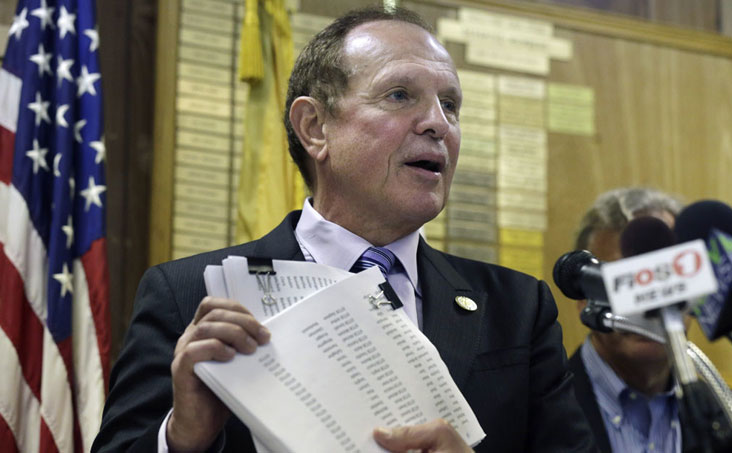
Former New Jersey state Senator Raymond Lesniak (l.)—a principal architect of the state’s fight to overturn a federal ban on sports betting—says that government regulation of sports betting information is needed. Lesniak said in a recent interview that regulation should be similar to the stock market to uncover unusual betting trends.
 Though an architect of New Jersey’s fight to overturn a federal ban on sports betting, former New Jersey state Senator Raymond Lesniak says he would like to see a unified regulation of sports data to help protect the integrity of sports betting.
In an interview with CDC Gaming Reports, Lesniak said state’s need to share sports betting information just as information on stock trading is monitored.
“That’s one thing that hasn’t happened yet but needs to happen,” Lesniak said. “Illegal acts are discovered by unusual investing patterns. There’s plenty of software around you can tie it in to raise red flags when a huge amount comes in on a certain game. That’s how these fixes are detected.
“States have to have uniform agreements to share the information. The operators can do it themselves, but government has to step in and make sure,” he said.
Lesniak also said that New Jersey’s move into sports betting and online casino gaming has greatly helped the state’s gambling market.
“Casino gambling and horse racing are not a young person’s sport anymore. But sports betting is,” he said. “It’s gone through the roof, as I expected. New Jersey and the Northeast are a hotbed of gambling.”
Lesniak said the Professional and Amateur Sports Protection Act, the 1992 federal legislation that effectively banned sports betting until overturned by the U.S. Supreme Court had a “noble intent” of stopping a proliferation of sports betting that could have threatened the integrity of sports.
“But that went out the window when Internet gambling came on board” and people could bet anywhere, Lesniak said. “There’s absolutely no reason for any state to not legalize sports betting. I’m just surprised more haven’t done it sooner.”