
Blackjack is a unique casino experience. It’s one of the few games where your decisions directly impact the house edge—it’s a true game of skill. If you want to play effectively, there are three “most important” things to do, depending on whether you are looking at the math, your wallet, or the rules.

Follow “Basic Strategy” (Math)
The single most important tactical thing you can do is use a Basic Strategy Chart. This isn’t a “hunch” or a “feeling”—it is the mathematically optimal way to play every single hand based on your cards and the dealer’s upcard. You can find basic strategy charts all over the internet. And while there are a few deviations that consider different rules, let’s start here.
Why it matters: Playing by your “gut” feelings usually gives the house a 2 percent to 5 percent edge. Following basic strategy perfectly can cut that edge down to about 0.5 percent.
Key moves to memorize:
- Always split Aces and 8s.
- Never split 10s or 5s.
- Double down on 11 against almost any dealer upcard.
- Stand on “stiff” hands (12–16) if the dealer shows a 2 through 6 (let the dealer bust).

Manage Your Bankroll (Survival)
You can be the best player in the world, but if you don’t manage your money, a short run of bad luck will wipe you out.

- The 5 percent Rule: Never bet more than 5 percent of your total session bankroll on a single hand.
- Buy-in: Ideally, bring at least 20 to 50 times the table minimum. If you’re at a $10 table, you should have at least $200–$500 to weather the natural “swings” of the game.

Avoid the “6-to-5” Trap (The Rules)
Before you even sit down, look at the felt. You want a table that pays 3:2 for Blackjack. If you live in Pennsylvania, thank your regulators. All casinos in PA are required to offer 3:2 rather than 6:5.
- Many modern tables (especially on the Las Vegas Strip) now pay 6:5. This might sound like a small difference, but it actually quadruples the house edge.
On a $10 bet, a 3:2 payout gives you $15; a 6:5 payout only gives you $12. Over a few hours, this is the difference between walking away a winner or a loser.


Pro-Tips for the Table
- Ignore “Insurance”: It is almost always a bad bet for the player. Statistically, it’s just a way for the casino to take more of your money.
- Don’t blame the “Anchor”: Many players get angry at the last person to act (the 3rd base) if they take a card that “should” have gone to the dealer. Mathematically, that player’s choice helps you just as often as it hurts you. Focus on your own cards.
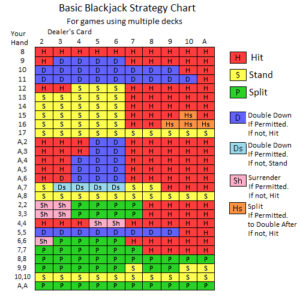
- Use a strategy card: Most casinos actually allow you to bring a small basic strategy card to the table with you. As long as you aren’t slowing down the game, they usually don’t mind!
- Stand on all 17s: Most Las Vegas casinos allow the dealers to hit a soft 17—a hand that consists of an Ace and a 6 or a selection of cards that add up to six. This rule gives the house a slightly higher edge, so choose a stand on all 17s table if you get a choice.
- Join the player’s club: Every casino has a players club, which rewards patrons for their loyalty. Even if you’re not going to play that much or you don’t plan on visiting the casino once a week, you may get offers that would be worth your while to return—everything from free play or match play, free or discounted rooms, or even a free meal or buffet. It costs nothing to join, and it lets them know you’re there.
21+. Gambling Problem? Call 1-800-GAMBLER