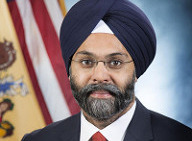
New Jersey’s Attorney General Gurbir Grewal has protested the federal Department of Justice’s new opinion on the federal Wire Act, which reversed a 2011 opinion that paved the way for the state to offer online gambling.
Pennsylvania Attorney General Josh Shapiro also signed the letter to the DOJ. Pennsylvania has legalized online gambling, which is still in the licensing phase and has introduced an online lottery system,
“We ask that DOJ withdraw its opinion altogether or assure us that DOJ will not bring any enforcement actions against companies and individuals engaged in online gaming in our states—where it is appropriate under state law,” the two attorneys general wrote to Matthew G. Whitaker, the acting U.S. attorney general.
Grewal has also filed a Freedom of Information Act request to determine if Las Vegas Sands owner Sheldon Adelson had influence over the new Wire Act opinion.
Adelson has long sought a federal ban on online gambling and funded a lobbying effort to have Congress take action. Those attempts, however, have gone nowhere and many analysts feel the DOJ opinion is an attempt to block online gambling from a different direction.
“Press reports indicate that pressure to reconsider the legality of online gaming followed lobbying efforts by Sheldon Adelson and affiliated lobbyists,” Grewal’s office said in a press release. “After Adelson’s Coalition to Stop Internet Gambling was unable to persuade Congress to address the issue, then-U.S.-Attorney General Jeff Sessions agreed to look into it. The New Jersey FOIA request seeks information on any communications involving Adelson, his lobbyists, the White House, and DOJ regarding the relevant federal law and online gaming.”
In the original letter, the two states express “strong objections” to the new opinion.
Grewal noted that online gaming in New Jersey, “generates $352.7 million in annual revenue and $60 million in direct gaming taxes—key both to New Jersey and to Atlantic City’s vitality. The Justice Department’s latest action is wrong on the law and wrong for New Jersey.”
New Jersey Governor Phil Murphy added “Our growing online gaming industry is a key component in revitalizing Atlantic City and strengthening New Jersey’s economy,” in a press statement.
The Wall Street Journal recently reported the legal reasoning behind the Wire Act reversal came from an April 2017 memo drafted by the Sands’ lobbyists. The memo, according to the report, was sent to top Justice Department officials in April 2017 and made a case that the 2011 opinion was incorrect.
“Nothing changed in the years since the Justice Department allowed online gaming to move forward, and there was no good reason for the Justice Department to rethink its prior decision,” Grewal said in a press statement. “Instead, media reports make clear that pressure to reconsider the opinion came from out-of-state casinos and their lobbyists. That is not a good enough reason to reverse course and undermine the online gaming industry. We want to know who Justice Department officials spoke with and why they decided to change their minds.”
The DOJ’s new opinion holds that the 1961 Wire Act applies to all forms of gambling that crosses state lines. The 2011 opinion held the act applied only to sports betting.
However, it is still unclear if the opinion—which does not carry the weight of law—will have any affect on online gambling conducted within a state’s borders. All three states that offer online gambling—New Jersey, Nevada and Delaware—only allow bets from within their borders.
But the opinion could affect the legal status of interstate lotteries such a PowerBall and Mega Millions as well as an agreement between Delaware, Nevada and New Jersey to share online poker pools.
Along with the letter, there are clear signs that New Jersey is readying to fight against any federal move to block the state’s online gambling industry.
Reports say former State Senator Raymond Lesniak—who was a major architect of the state’s online gaming laws—has been asked by current Senate President Stephen Sweeney to prepare a response to the DOJ opinion.
“The new Justice Department opinion threatens the significant boost enjoyed by New Jersey casinos, the jobs and state revenues from online gaming and it could have a negative impact on sports betting at our casinos and racetracks,” Sweeney said in a press statement. “We don’t want to lose the hard-fought gains that are helping to revive Atlantic City and the state’s gaming industry.”
Lesniak has said previously that he expects the opinion will be challenged by the state in court. According to some reports, he has already advised Sweeney that both the state legislature and state gaming regulators should prepare to file for a declaratory judgment on the opinion in U.S. District Court.