
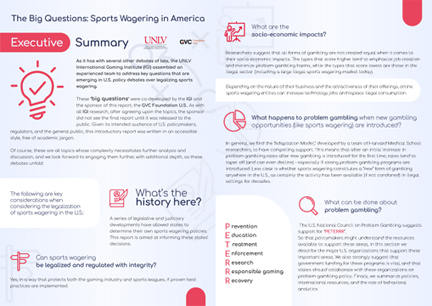
A series of judiciary and legislative developments have allowed states to determine their own sports wagering policies. The UNLV International Gaming Institute has published a report aimed at informing these states’ decisions, which can be found here (report) and here (infographic).
The 33-page assessment, “The Big Questions: Sports Wagering in America,” poses and answers a broad range of questions faced by legislators and regulators. These include:
- Can sports wagering be legalized and regulated with integrity?
- What are the youth gambling impacts?
- In jurisdictions where sports wagering and/or online gambling is not legalized, what happens in the illegal marketplace?
- Overall, what are Americans’ perceptions of gambling?
The study was sponsored by GVC Foundation U.S., a nonprofit dedicated to promoting responsible gambling and sports integrity. The major questions set down in the report were co-developed by the IGI and GVC Foundation U.S. GVC will not see the report until it is issued to the public, ensuring academic and research integrity. The research team anticipates more detailed reports as these issues evolve.
“Our goal in drafting questions for the study was to highlight all major aspects of sports betting–the good, the bad and the ugly,” said Martin Lycka, Trustee of GVC Foundation U.S. and director of regulatory affairs for GVC Holdings. “For sports betting to be the fun, safe, and well-structured enterprise that it’s meant to be, our industry needs to commit to honestly presenting its unique components to all regulators and legislators alike.”
“We expect to see a surge in the popularity of sports betting as the U.S. acclimates to this ‘new normal.’ As researchers, we want to ensure that this industry is regulated in a way that fosters the socio-economic benefits of gambling while minimizing its harms,” said Bo Jason Bernhard, executive director of UNLV IGI. “As always, the IGI seeks to shed academic light on the major debates of the day, bringing together our ‘dream team’ of experienced and multi-disciplinary thinkers to weigh in on the big questions. Today, U.S. policymakers can rely on an independent evaluation that covers a range of key issues, thanks to this first-of-its-kind report.”
Also participating in the study were Jennifer Shatley, an experienced responsible gaming executive with a 22 year career background involving extensive leadership progressing responsible gaming policy and former vice president, responsible gaming policies and compliance for Caesars Entertainment; and Alan Feldman, the chairman of both the International Center for Responsible Gaming as well as the Nevada Advisory Committee on Problem Gambling, and a former longtime executive with MGM Resorts and Mirage Resorts.