The last time we saw the Miami Hurricanes play for a national championship was January 3, 2002. Miami defensive end and future NFL first-round pick Akheem Mesidor was two days shy of nine months old, meaning the only things he was sacking were diapers and stuffed animals. But even before the turn of the century, Miami was the team to beat in college football. Starting with legendary coaches Howard Schnellenberger and followed by Jimmy Johnson and Dennis Erickson, the Hurricanes were the most colorful team in college football. But those days are long gone.
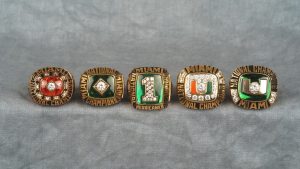
In fact, since joining the ACC in 2004, Miami has never won a conference title. The closest the Hurricanes came was 2017, when Clemson dismantled them, 38-3, in the ACC title game. It’s been 20 years since Miami won a major bowl game before this year.
The last time the Indiana Hoosiers played for a national championship was, well, never in anyone’s lifetime. The Hoosiers finished fourth in the nation in 1945, last played in a Rose Bowl Game in 1967, and have played in only 13 postseason games ever.

Now that you know the brief pedigrees, let’s dive in further as to why we’re seeing these two Monday night—and we make no apologies for the ageism.
Old & Experienced
We bring the age factor up here not just to point out how long it’s been since either the Hurricanes or Hoosiers were relevant, but how important that age factor is in determining why Miami and Indiana are the last two teams standing.
According to “The Next Round” meme making the rounds, Indiana has 47 players aged 22-25, making the Hoosiers one of the oldest teams in college football history. One source lists the average age of an Indiana starter as 23.2 years old. Miami? 22.6. Putting that into perspective, there are currently 147 players on NFL rosters who are 21 or 22.

Age matters. Experience matters, especially when you get to the pinnacle of the sport. Putting a 20-year-old with no more than two years of college experience against a 23-year-old with five or six is like bringing a slingshot to Omaha Beach on D-Day.
Last week, we saw Miami survive a 31-27 Fiesta Bowl shootout with Ole Miss that neatly tucked into the 3.5-point spread, even as it torpedoed our Under-57. And Indiana’s 56-22 Peach Bowl poleaxing of Oregon wasn’t that close, but taking the Hoosiers -3.5 may have been the easiest bet cashed all season.
Now… what’s next?
Last week: 2-1. Season (ATS): 33-28.

Keys to Successs
How do you beat Indiana? Well, we don’t know the answer to that question, because nobody-not Oregon (twice), Ohio State, Alabama, or Penn State (who came perhaps the closest) has been able to answer it.
What we can answer is that the Hoosiers don’t beat themselves. They rank among the top two teams in the nation in turnover margin and penalties per game, and rank No. 1 in fumbles lost. Simultaneously, they punish you on both sides of the ball with a ruthlessness bordering on the sadistic. The Hoosiers are ranked second in FBS in scoring defense (11.1 points per game) and fifth in scoring offense (42.6 points per game), averaging 7 yards per play (fifth) and 461 yards of offense (fifth).
Those numbers translate into a 15-0 team that allowed only three teams: Iowa (20-15), Penn State (27-24), and Ohio State in the Big 10 Championship (13-10) within one score.
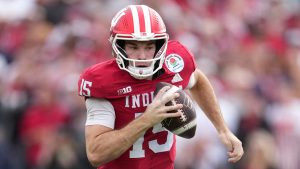
So how does Miami counter that? How do the Hurricanes neutralize Indiana’s Heisman Trophy-winning QB Fernando Mendoza, he of the 71.5 percent completion rate, 3,349 yards, 33 passing TDs, 240 rushing yards, and six rushing TDs? Illustrating the kind of run Mendoza—likely the No. 1 pick in this spring’s NFL Draft—is on, he’s thrown eight TDs and five incompletions in Indiana’s two CFP blowouts.
We answer that with the key matchup of this game, the first among equals of deciding factors: Mendoza and WRs Elijah Sarratt, Omar Cooper Jr., and Charlie Becker vs. Miami’s feral pass rush and secondary.

Behind Mesidor and Rueben Bain Jr., the ACC Defensive Player of the Year, the U ranks second in the nation in sacks per game (3.1). Mesidor and Bain have combined for 19 sacks—including 7.5 in the Hurricanes’ three CFP games—119 pressures and five forced fumbles. Miami’s 54 team sacks lead the nation, and the Hurricanes’ ability to pressure opposing QBs is second to none.
Offense Vs. Defense
It won’t come easy. That irresistible force runs into an immovable object—an Indiana offensive line that allowed 1.5 sacks per game. According to Pro Football Focus, Indiana ranks 16th in team pass-blocking, grading at 78.2. This means Mendoza has generally feasted on opposing defenses at his leisure, hitting Sarratt (62 catches, 802 yards) for a nation-leading 15 TD passes, finding Cooper for a team-best 64 passes and 866 yards to go with 13 TDs, and using Becker (30-614-4) as a lethal deep threat. Becker is averaging 20.2 yards per catch and has receptions of 30, 36, and 51 yards in his last three games.
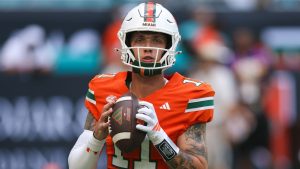
Put aside whether you trust Miami QB Carson Beck in this situation, whether the Miami run game can continue the run its on, or any other matchup variable. And put aside for the moment that both Miami and Indiana are 4-0 ATS in their last four games, with Miami outrunning the bookmakers by 13 points in those four games and Indiana outrunning the books by an average of 22.3 points in its last four games.
This game will be decided by Mesidor, Bain and Co’s. ability to do what 14 other teams haven’t been able to do this season—rattle Mendoza into mistakes, dominate the line of scrimmage, and make the Hoosiers uncomfortable.
Our answer? We like this particular Mendoza Line.
Best Bet: Indiana -8.5 (-110 at BetMGM).
21+. Gambling Problem? Call 1-800-GAMBLER